

Project Background
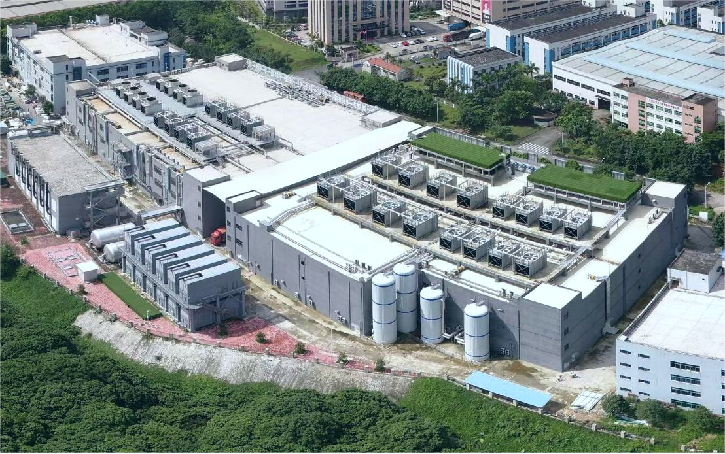
Tencent’s Guangzhou Yongshun Data Center is located at 16 Huanling Road, Huangpu District, Guangzhou. Its smaller system serves approximately 900 racks, while the larger system serves around 1,000 racks, covering a total cooled area of approximately 18,000 square meters. Operating year-round, the data center requires its central air conditioning system to meet rack cooling and environmental stability requirements while maintaining high energy efficiency across varying loads.
In large data centers, chillers, chilled-water pumps, cooling-water pumps, cooling towers, and terminal air conditioning units interact with one another. Adjusting individual units alone often fails to account for the cooling system’s overall energy performance. Effective monitoring, modeling, and optimization therefore require a system-wide approach.
Project Scope
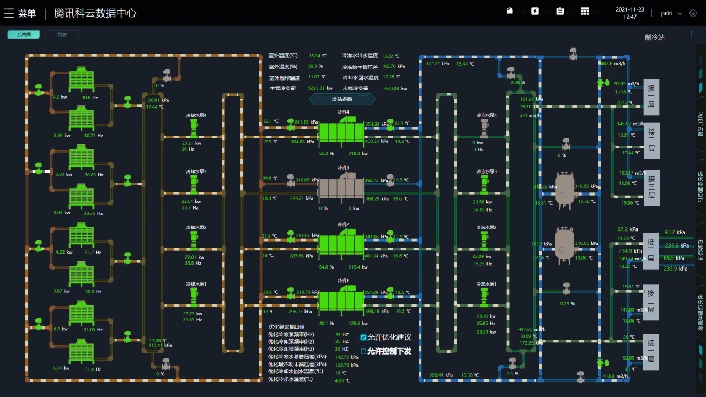
The project introduced an AI-powered energy optimization and control system for central air conditioning. It manages the data center’s ventilation and air conditioning infrastructure as an integrated whole, using intelligent control to improve overall efficiency. Real-time data provides visibility into cooling generation, distribution, and terminal equipment, enabling coordinated optimization of key control parameters while meeting server room environmental requirements.
Coordinated Control of the Cooling Plant and Terminal Units
Chillers, chilled-water pumps, cooling-water pumps, and cooling towers work together as part of the cooling system. AI optimization focuses on overall equipment combinations and operating settings in response to changing server room loads, matching cooling capacity more closely to actual demand.
Real-Time, Data-Driven Control
The platform continuously collects equipment and environmental data, identifies changes in energy consumption under different operating conditions, and translates its findings into actionable control strategies. This closed loop of monitoring, analysis, decision-making, and execution reduces the constraints that fixed setpoints and reliance on operator experience place on system efficiency.
Energy Savings Results
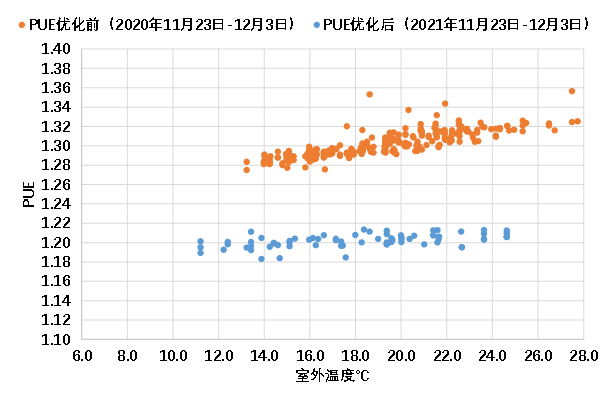
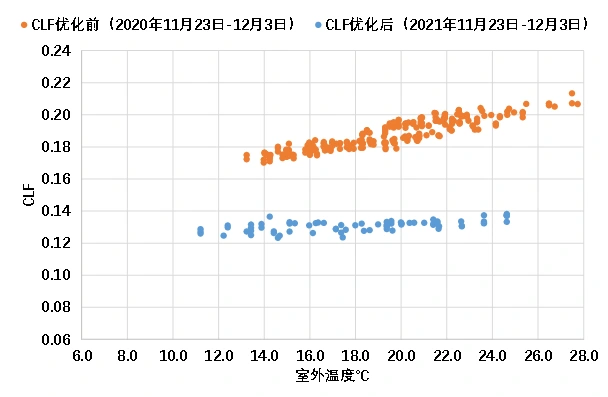
Measured comparisons reported in the original article show a 28% reduction in CLF and cooling plant energy savings of over 20% following the upgrade. Estimated annual electricity savings exceed 1.75 million kWh, with an annual average PUE below 1.25. These results demonstrate the value of optimizing the central air conditioning system as a whole.
Implications for Data Center Energy Efficiency
This project demonstrates how data centers can achieve further cooling efficiency gains by improving system control logic while maintaining core operations. A unified AI energy optimization platform provides visibility across cooling generation, distribution, and terminal equipment, supporting traceable operating data and continuous optimization. The project offers a practical reference for similar data centers seeking to improve central air conditioning efficiency.