


Project Background
The opening ceremony of the 15th National Games recently took place at the Guangdong Olympic Sports Center, drawing nationwide attention to southern China. As China’s first carbon-neutral National Games, the event embedded low-carbon principles throughout venue construction and event operations.
Gokin Solar played an important role behind the scenes. Its high-performance TOPCon modules supported energy upgrades at three core venues, harnessing local sunshine to help deliver the Games’ carbon-neutral vision.
New Energy Efficiency Challenges for a Global Solar Manufacturer
Ranked among the world’s top 500 new energy companies, Gokin Solar operates across monocrystalline silicon ingots and wafers, photovoltaic modules, and solar power plants. Its business spans more than 30 countries and regions, including the United States, Germany, Italy, and Malaysia, with four manufacturing bases and five power plant business development centers worldwide.
As the company expands, it faces a challenge shared by many manufacturers: maximizing energy efficiency and controlling costs in large-scale production.
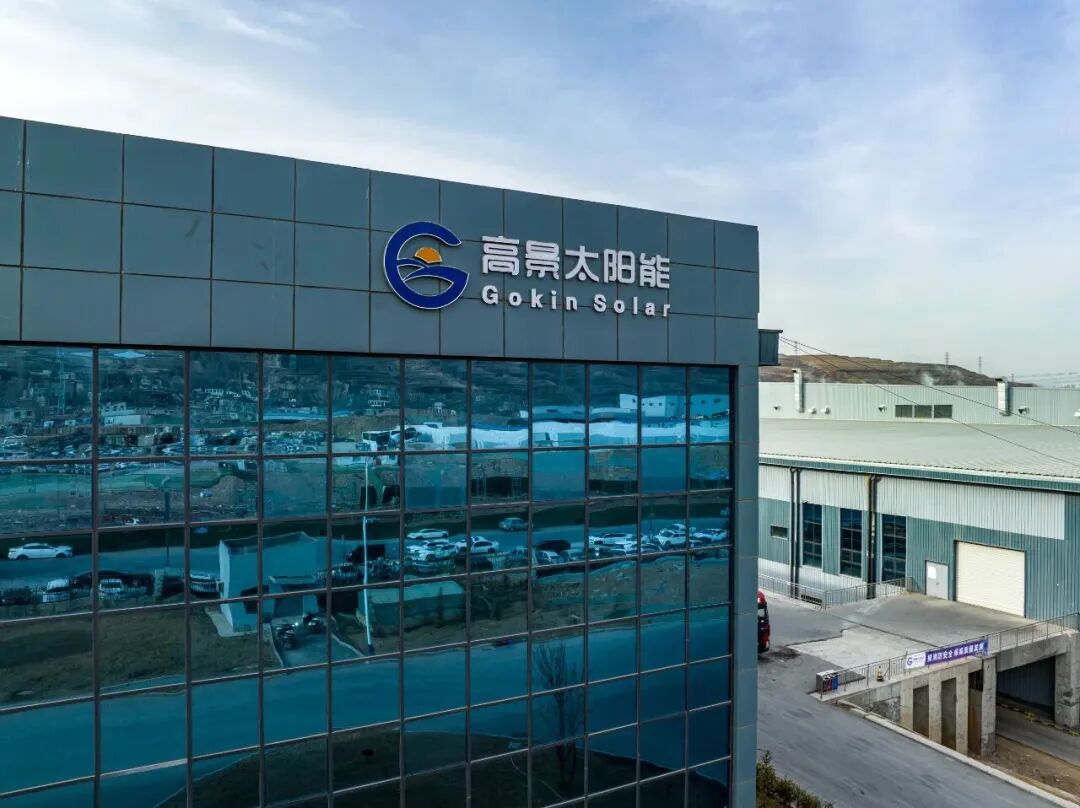
Gokin selected its Xining manufacturing base for a systematic energy optimization and intelligent control upgrade, addressing two main challenges.

1. Limited Integrated Management Capabilities
Although the large campus had a relatively comprehensive equipment automation system for monitoring key utility plant data, its subsystems operated independently, creating significant data silos. Control, maintenance, reporting, and analysis relied on manual work, making energy consumption and costs difficult to track precisely.
2. Heavy Maintenance Workloads and Fragmented Control
The site’s scale and demanding production processes placed considerable pressure on the facilities team. Operating parameters for HVAC equipment, chillers, and pumps were set manually. The system lacked energy performance monitoring, including COP and SCOP, and chillers had no coordinated sequencing control.
Each subsystem followed its own closed-loop control logic, preventing dynamic adjustment to real-time demand and resulting in wasted energy.
PhyAI Improves Facilities Management and Energy Control
To address these challenges, Deepctrls built an integrated Facility Monitoring and Control System (FMCS) on its proprietary DeepOS platform. The solution gives Gokin clear visibility into energy use and the tools to manage and control it efficiently.
Building on this digital foundation, Deepctrls introduced DeepSYS and PhyAI intelligent energy control to extend optimization from facilities management to overall energy performance.
Within DeepSYS, Deepctrls developed a comprehensive physical simulation model covering chillers, cooling towers, pumps, major equipment, and load characteristics. Edge servers collect equipment and environmental data in real time. Proprietary PhyAI algorithms and large AI models then identify optimal operating strategies across the entire system.
Under the same load conditions, the platform evaluates tens of thousands of parameter combinations to identify the lowest-energy solution. It dynamically sends control settings to equipment, creating an AI-driven feedback loop that continuously learns and optimizes.
The project delivers the following benefits:
10% electricity savings.
Estimated annual energy cost savings of approximately RMB 700,000.
Longer equipment life through consistently optimized operating power.
Lower energy consumption and carbon emissions, supporting environmental requirements and strengthening green competitiveness.
By combining DeepOS and DeepSYS with PhyAI, Deepctrls has helped Gokin Solar establish an integrated management approach that saves electricity, reduces costs, eases workloads, and simplifies operations.
From supporting the carbon-neutral National Games to advancing greener solar manufacturing, Gokin Solar and Deepctrls are using PhyAI to accelerate low-carbon production. The partners plan to expand their collaboration across additional sites and continue improving green, intelligent manufacturing.

